U.S. Special Envoy for Sudan Major General Gration has made his first visit to Sudan, during which he met extensively with the government and visited a few refugee camps. He expressed the United States's interest in establishing friendly and cooperative relations with the Sudanese government, which was very well received. He did, however, express concern with the humanitarian aid situation, which he considers on the brink of crisis.
To read more, visit: http://sudanwatch.blogspot.com/2009/04/sudans-bashir-hails-obamas-overture-to.html.
UNAMID Report from April 13, 2009 stated that during the past 72 hours, activity in Darfur has been realtively calm. The second regular meeting of Darfur Human Rights Forum will be held in West Darfur, brining together government officials from local and national groups, emmbers of the advisory council on human rights, the African Union, UNAMID and UNMIS officials, and the Darfur State Committees on Violence Against Women. The goal of the Forum is to provide "transparent and constructive dialouge on human rights issues between the Sudanese government and UNAMID."
To read more, visit: http://appablog.wordpress.com/2009/04/13/darfur-unamid-daily-media-brief-15/
A two-day cease fire has been declared in Sri Lanka to allow emergency humanitarian aid to catch up to the ongoing conflict. Officials estimate that between 150,000 and 190,000 civilians unrelated to the government and the LTTE are currently stuck in a northern region called the Vanni Pocket. The Vanni Pocket is approximately the size of Manhattan.
To read more, visit: http://www.reliefweb.int/rw/rwb.nsf/db900SID/RMOI-7R2L25?OpenDocument&RSS20=18-P
Monday, April 13, 2009

Friday, April 10, 2009
News Update 4/10/09
US Envoy has "constructive" talks with Sudanese Foreign Minister
KHARTOUM, April 8 (Xinhua) -- The special envoy of the U.S. president to Sudan Scott Gration said on Wednesday that he held "constructive" talks with Sudanese Foreign Minister Deng Alor on the situations in the western Sudanese region of Darfur and southern Sudan.
KHARTOUM, April 8 (Xinhua) -- The special envoy of the U.S. president to Sudan Scott Gration said on Wednesday that he held "constructive" talks with Sudanese Foreign Minister Deng Alor on the situations in the western Sudanese region of Darfur and southern Sudan.
The U.S. envoy told reporters at the end of the meeting that he briefed the Sudanese foreign minister on the results of his visits to Darfur and Juba, the capital of southern Sudan, as well as Abyei, a disputed area between northern and southern Sudan.
He said that he found the situation in some areas in Darfur much better than what he had expected in particular with regard to the food, while the situation in some other areas was worse especially in the areas of water and health care.
He added that a coordination between all parties concerned was necessary to improve the situation of displaced persons in Darfur and improve their poor nutrition condition.
Gration noted that the priorities for the next phase would focus on addressing the emergency situation in Darfur in the humanitarian and security fields and reach a ceasefire between the conflicting parties.
The Sudanese foreign minister, on his part, expressed his confidence that the visit of the U.S. envoy to Sudan would help the new U.S. administration to deal with Sudan in the coming period.
He disclosed that senator John Kerry, the chairman of the Committee on Foreign Relations in the U.S. Senate, would visit Sudan in the next week, adding that Kerry's visit would be an extension of the U.S. envoy's visit that would contribute to the development of the U.S. strategy for dealing with Sudan in the next phase.
Gration, a former U.S. Air Force major general, arrived in Sudan last Thursday on his first visit to the African country since he was appointed the special envoy by U.S. President Barack Obama.
Article citation: http://news.xinhuanet.com/english/2009-04/09/content_11152761.htm
----------------------------------------------
Let them decide: Civilians trapped with Tamil Tiger fighters must be offered an exit before a bloodbath ensues
Source: United Nations Office for the Coordination of Humanitarian Affairs (OCHA)
Date: 08 Apr 2009
by John Holmes, first published by The Guardian
As London witnesses Tamil protests, a bloodbath on the beaches of northern Sri Lanka seems an increasingly real possibility. The Sri Lankan military has pushed the Liberation Tigers of Tamil Eelam into an area so small that any shooting or shelling inevitably causes casualties among the 150,000 to 190,000 civilians trapped in the same zone. There have been many hundreds of civilian deaths caused by firing from both sides, though exact numbers and who fired what and when are impossible to verify. It is clear that the LTTE is refusing to let people flee, though many are managing to escape somehow, and I fear the combatants may be gearing up for a final confrontation. This is a very grave situation.
As a full-scale, long-term ceasefire is unlikely to be agreed now, the only way to get the civilians out of harm's way is a temporary humanitarian lull, during which aid workers and relief supplies must be allowed into the conflict zone, and those who want to leave must be given the chance to do so.
Both sides have a duty to bring this about. The LTTE's leadership claims the civilians in the conflict zone do not want to leave because they accompanied the LTTE voluntarily in the first place and are afraid of government reprisals. Yet there are continuing reports that the group's fighters are shooting at fleeing civilians, limiting fishing and sabotaging boats that might be used to escape, and forcing people to fight against their will. Civilians trapped by the fighting must be allowed a free choice of whether to leave or stay, as we have made clear to the LTTE. If the LTTE truly has the best interests of the Tamil people at heart, they should contribute to ending this unnecessary civilian suffering.
....
To read more, visit: http://www.reliefweb.int/rw/rwb.nsf/db900SID/EDIS-7QWKT5?OpenDocument&RSS20=18-P
------------------------------------------------------------------
Over 180 Civilians Killed, Most by Rwandan Rebels
A Democratic Forces for the Liberation of Rwanda (FDLR) soldier walks toward a distribution center near Lushubere Camp in Masisi, North Kivu.
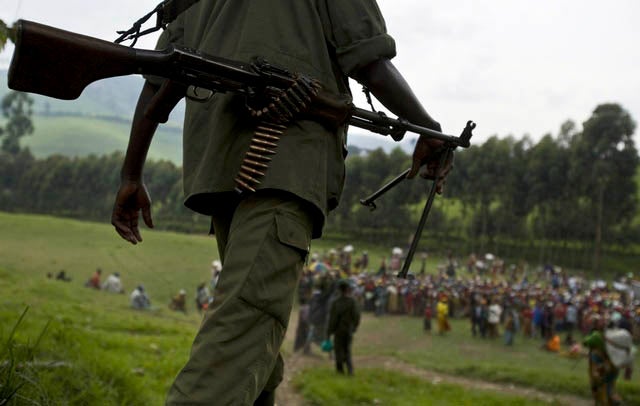
The United Nations Security Council will discuss on April 9 the latest report by the UN secretary-general on the peacekeeping force in Congo. Human Rights Watch called on the UN Security Council to press the Congolese government to remove human rights abusers from its armed forces and end rights violations, including attacks against women and girls.
....
To read more, visit: http://www.hrw.org/en/news/2009/04/08/dr-congo-brutal-rapes-rebels-and-army
Monday, April 6, 2009
Thank you!
Thanks to all who helped to send letters to Louise Slaughter in Douglass on Friday!!
During lunchtime, we sent 76 letters to Louise Slaughter encouraging her to put pressure on Obama to continue the comprehensive policy analysis on Darfur so that the US can make policy decisions about Darfur soon.
During lunchtime, we sent 76 letters to Louise Slaughter encouraging her to put pressure on Obama to continue the comprehensive policy analysis on Darfur so that the US can make policy decisions about Darfur soon.
Wednesday, March 4, 2009
Sri Lanka News
UN official says Sri Lanka situation "grim"
Source: Deutsche Presse Agentur (DPA)
Date: 04 Mar 2009
Geneva_(dpa) _ The humanitarian situation in north-eastern Sri Lanka has become "extremely grim," a senior United Nations official in the Asian country said Wednesday.
Gordon Wiess, the spokesman for the UN's operations in Sri Lanka warned that some 70,000 to 200,000 were trapped in a tiny enclave between a lagoon and the sea front, desperate for food, shelter and drinking water.
He said it was "unacceptable" that civilians were cut off from aid. "There is virtually no humanitarian access to the enclave. Nothing like what is needed to sustain the population inside there," Wiess said in a telephone interview.
...
To read more, visit: http://www.reliefweb.int/rw/rwb.nsf/db900SID/ASAZ-7PTEGB?OpenDocument&RSS20=18-P
ARREST WARRANT ISSUED FOR BASHIR
Warrant issued for Sudan's Bashir
Sudan's president has denied committing war crimes
The International Criminal Court has issued an arrest warrant for Sudan's president on charges of war crimes and crimes against humanity in Darfur.
However, the court stopped short of accusing Omar al-Bashir, who denies the charges, of committing genocide.
Reports say Sudan's capital, Khartoum, was tense as people awaited the decision, with fears of unrest.
The UN estimates some 300,000 people have died and millions been displaced in six years of conflict in the region.
The spokeswoman for the court in The Hague, Laurence Blairon, said Mr Bashir was suspected of being criminally responsible for "murdering, exterminating, raping, torturing and forcibly transferring large numbers of civilians and pillaging their property".
She said the violence in Darfur was the result of a common plan organised at the highest level of the Sudanese government, but there was no evidence of genocide.
The court would transmit as soon as possible to the government of Sudan a request for his arrest and surrender, she added.
It is the ICC's first ever warrant issued against a sitting head of state.
ICC prosecutor Luis Moreno-Ocampo had requested that the court issue a warrant for Mr Bashir's arrest in July 2008.
http://news.bbc.co.uk/2/hi/africa/7923102.stm
Tuesday, March 3, 2009
News Update 3/3/09 - Bashir's Indictment Ruling Tomorrow
With word about Bashir's indictment expected from the International Criminal Court tomorrow, things are heating up:
Sudan president tells court to ''eat'' expected warrant:
KHARTOUM (Reuters) - Sudan's President Omar Hassan al-Bashir was defiant towards the International Criminal Court Tuesday, telling it to "eat" an expected warrant for his arrest for alleged war crimes in Darfur.
"They will issue their decision tomorrow ... this coming decision, they can prepare right now: they can eat it (the warrant)," Bashir told a crowd of cheering supporters who lit and stamped on an effigy of ICC prosecutor Luis Moreno Ocampo.
Bashir's comments were made at the opening of a hydroelectric dam in Merowe, northern Sudan, a day before ICC judges were due to respond to a request by Ocampo for an arrest warrant for Bashir on charges of war crimes in the Darfur region of western Sundan.
....
The opening of the dam, billed by Bashir as "the beginning of the end of poverty in Sudan," was attended by dignitaries from Arab states, as well as Chinese officials, and executives from European and Chinese companies involved in the project.
Bashir used the occasion to announce cuts in electricity prices, for the poor and for industry and agriculture, ranging between 25-30 percent.
Tensions have risen in Sudan as it awaits the decision by the ICC, which China, the African Union and the Arab League have warned could destabilise the region, worsen the Darfur conflict and threaten an already troubled peace deal between north Sudan and the semi-autonomous south.
....

Photo: Sudanese President Omar Hassan al- Bachir addresses an assembly of politicians, religious leaders, artists and students from Sudan's eastern provinces in Khartoum, March 1, 2009. (REUTERS/Zohra Bensemra)
To read more, visit: http://sudanwatch.blogspot.com/2009/03/sudan-president-tells-court-to-eat.html.
-----------------------------------------------------------------------
President Isaias [of Eritrea] assured the delegation that as the move being taken by the International Criminal Court (ICC) against President Omar Hassan Al-Beshir not only targets the Sudanese leader and the Sudan itself but also the entire countries of the region, Eritrea would not accept it and would stand alongside the Sudanese people.
Dr. Nafie Ali Nafie on his part lauded the firm stance of President Isaias, as well as the people and Government of Eritrea in rejecting the ICC issue and the efforts they are exerting towards promoting a comprehensive peace and justice in the Sudan. In this respect, he described such a stance as “correct and courageous.”
Stating that the interference of the International Criminal Court would only aggravate the Sudanese issue in general and that of Darfur in particular rather than bring about solution, Dr. Nafie underlined that the ICC issue would undermine regional peace and prompt neo-colonialism in Africa.
To read more, visit: http://sudanwatch.blogspot.com/2009/03/eritrea-rejects-icc-issue-and-stands.html.
--------------------------------------------------------------------------
Opinion Piece by Desmond Tutu, featured in the NYTimes
Will Africa Let Sudan Off the Hook?
(Cape Town) The expected issuance of an arrest warrant for President Omar Hassan al-Bashir of Sudan by the International Criminal Court tomorrow presents a stark choice for African leaders — are they on the side of justice or on the side of injustice? Are they on the side of the victim or the oppressor? The choice is clear but the answer so far from many African leaders has been shameful.
Because the victims in Sudan are African, African leaders should be the staunchest supporters of efforts to see perpetrators brought to account. Yet rather than stand by those who have suffered in Darfur, African leaders have so far rallied behind the man responsible for turning that corner of Africa into a graveyard.
....
To read more, visit: http://www.nytimes.com/2009/03/03/opinion/03tutu.html?partner=rssnyt&emc=rss.
---------------------------------------------------------------------------------------
To read more, visit: http://www.reliefweb.int/rw/rwb.nsf/db900SID/MSAO-7PS4VQ?OpenDocument&RSS20=18-P.
-----------------------------------------------------------------------
Eritrea rejects ICC issue and stands alongside the Sudanese people
Source: The State of Eritrea's Ministry of Information at shabait.com (hat tip AllAfrica) by Staff March 2, 2009:President Isaias [of Eritrea] assured the delegation that as the move being taken by the International Criminal Court (ICC) against President Omar Hassan Al-Beshir not only targets the Sudanese leader and the Sudan itself but also the entire countries of the region, Eritrea would not accept it and would stand alongside the Sudanese people.
Dr. Nafie Ali Nafie on his part lauded the firm stance of President Isaias, as well as the people and Government of Eritrea in rejecting the ICC issue and the efforts they are exerting towards promoting a comprehensive peace and justice in the Sudan. In this respect, he described such a stance as “correct and courageous.”
Stating that the interference of the International Criminal Court would only aggravate the Sudanese issue in general and that of Darfur in particular rather than bring about solution, Dr. Nafie underlined that the ICC issue would undermine regional peace and prompt neo-colonialism in Africa.
To read more, visit: http://sudanwatch.blogspot.com/2009/03/eritrea-rejects-icc-issue-and-stands.html.
--------------------------------------------------------------------------
Opinion Piece by Desmond Tutu, featured in the NYTimes
Will Africa Let Sudan Off the Hook?
(Cape Town) The expected issuance of an arrest warrant for President Omar Hassan al-Bashir of Sudan by the International Criminal Court tomorrow presents a stark choice for African leaders — are they on the side of justice or on the side of injustice? Are they on the side of the victim or the oppressor? The choice is clear but the answer so far from many African leaders has been shameful.
Because the victims in Sudan are African, African leaders should be the staunchest supporters of efforts to see perpetrators brought to account. Yet rather than stand by those who have suffered in Darfur, African leaders have so far rallied behind the man responsible for turning that corner of Africa into a graveyard.
....
To read more, visit: http://www.nytimes.com/2009/03/03/opinion/03tutu.html?partner=rssnyt&emc=rss.
---------------------------------------------------------------------------------------
Peacekeepers will stay in Darfur even if Sudanese President indicted – UN official
Source: United Nations News Service
Date: 02 Mar 2009
With the International Criminal Court (ICC) expected to announce its decision on seeking an arrest warrant for Sudanese President Omar Al-Bashir on charges of war crimes this week, the chief of United Nations peacekeeping operations today said that the joint UN-African Union mission in Darfur (UNAMID) will continue its patrols protecting the local population.
Speaking to the press at UN Headquarters in New York, Under-Secretary-General for Peacekeeping Operations, Alan Le Roy, said that he is assured that peacekeepers in Darfur will not come under threat should the ICC indict President Al-Bashir.
"The Government would assume its full duty of protecting UN missions in Sudan against any negative impact that may result from ICC possible decision against the Sudanese political leadership," Mr. Le Roy told journalists in a wide-ranging briefing on the work of the 18 UN peacekeeping missions around the world.
....To read more, visit: http://www.reliefweb.int/rw/rwb.nsf/db900SID/MSAO-7PS4VQ?OpenDocument&RSS20=18-P.
Monday, March 2, 2009
Weekly News Update 3/2/09
DARFUR
1. Genocide Intervention Network recently released an analysis of fatalities due to violence in Darfur from January 1 - September 8, 2008. The persons included do not include those who have died due to hunger and disease (up to 80% of Darfurian deaths) and other sources of violence, including sexual violence. According to GI-Net's statistics, approximately 150 people have died due to violence per months.
To see more, please see Alex de Waal's critique at: http://www.ssrc.org/blogs/darfur/2009/02/26/data-for-deaths-in-darfur/
2. Recently, the Chairman of the African Union has blamed foreign forces for conflicts in Africa. Specifically, he has referenced the recent meetings between Darfurian rebel leaders opening offices in Tel Aviv and holding military meetings there. Ha'aretz, a major Israeli newspaper, published an article stating that a leader of one of the rebel groups in Sudan's Darfur region recently visited Israel to discuss with a senior Israeli official the situation in the Sudan. Currently, Israel houses upwards of 600 refugees, whom Olmert's regime granted asylum and work permits.
To see more, please see http://sudanwatch.blogspot.com/2009/02/au-chairman-hard-evidence-proves-israel.html
3. Columbia University's Professor Mamdani, a native Ugandan and the Chair of the Council for Development of Social Science Research in Africa, says that defining the Darfur conflict as the West traditionally has as Arab vs. African is misconstrued. He states, "When the Save Darfur movement claims that this violence is African versus Arab its explanation is not historical or political. Its explanation basically is that the Arabs are "race-intoxicated" and they are just trying to wipe out the Africans. The Save Darfur movement does not educate the people they mobilize about the history of Darfur. It does not educate them about what issues drive the conflict. So they know nothing about the politics of Darfur, the history of Darfur, the history of the conflict. All they know is that Darfur is a place where "Arabs" are trying to eliminate "Africans". That's all. Darfur is a place where "evil lives", so they have completely "moralized" the conflict and presented it as a struggle against evil. This evil is thus portrayed as ahistorical, or trans-historical, living outside of history — except that evil is said to live in this place called Darfur and Sudan."
To see more, please visit: http://sudanwatch.blogspot.com/2009/02/defining-darfur-conflict-as-arab.html.
4. 5000 rebels are congregating on the Sudanese side of the Sudanese-Chadian border, awaiting the world on the ICC's indictment of Bashir. The international community fears that should Bashir be indicted, the rebels will act. JEM leader Khalil Ibrahim has vowed to topple Bashir, stating "we are not going to ask to control Darfur and Kordofan through peace talks if they [the government] are not going to give it - we'll take it."
To see more, please visit: http://www.google.com/reader/view/#search/congregating/1.
SRI LANKA
1. The LTTE does not want to agree to peace talks with the government. Thousands have fled from the North in the Vanni pocket, on the run from fighting in the North, including shelling. Those fleeing are often separated from their families and have no idea of their villages' fates. The World Health Organization (WHO) warns of health epidemics, should the current health issues continue to deteriorate as they are.
To see more, please visit: http://www.reliefweb.int/rw/rwb.nsf/db900SID/TUJA-7P47XH?OpenDocument&RSS20=18-P.
Subscribe to:
Posts (Atom)